
Have you ever noticed that when conflict arises, you tend to get defensive, walk away, shut down, or immediately try to make everything okay?
These reactions may feel automatic, almost as though your body responds before you've had a chance to think. That's because, in many cases, they are.
Psychologists often refer to these patterns as the four F's of survival: fight, flight, freeze, and fawn. These responses are part of how our nervous system responds to perceived threats and attempts to protect us when we feel unsafe, overwhelmed, or emotionally vulnerable.
Interestingly, the ways we respond to stress as adults can be influenced by what we learned about safety, connection, and relationships during childhood.
Understanding your survival response can offer valuable insight into your emotional patterns, particularly when it comes to navigating conflict and intimacy in your relationship.
What Are the Four F's of Survival?
Our nervous system is constantly scanning our environment for cues of safety and danger. When it detects a potential threat, it can activate automatic protective responses designed to help us cope.
These responses aren't conscious decisions or character flaws. They are often learned adaptations that helped us navigate difficult or unpredictable experiences.
While everyone experiences these responses from time to time, we may develop a tendency to rely more heavily on one or more of them, particularly when we're feeling emotionally threatened.
Let's take a closer look at each one.
1. Fight: "I need to take control to feel safe."
The fight response is often associated with anger, defensiveness, control, or confrontation. When someone feels threatened, their instinct may be to stand their ground, push back, or regain a sense of control.
How might this develop in childhood?
Children who develop a stronger fight response may have grown up in environments where they frequently felt powerless, criticized, threatened, or unheard.
Some potential childhood experiences include:
- Growing up with an authoritarian, controlling, or highly critical parent.
- Having emotions dismissed, invalidated, or punished.
- Being exposed to frequent conflict, yelling, or aggression.
- Having to fight to have their needs acknowledged.
- Experiencing bullying, intimidation, or power imbalances.
- Learning that showing vulnerability wasn't safe.
How can this show up in adulthood?
- Becoming defensive quickly.
- Responding to perceived criticism with anger.
- Needing to be right or have the last word.
- Becoming controlling when feeling anxious or uncertain.
- Escalating conflict rather than withdrawing.
- Having difficulty acknowledging the hurt or vulnerability underneath anger.
At its core, the fight response may be driven by a belief such as:
"If I don't stand up for myself, I'll get hurt, dismissed, or taken advantage of."
2. Flight: "I need to get away to feel safe."
The flight response is characterized by an urge to escape, avoid, or distance yourself from something that feels uncomfortable or threatening.
For some people, this means physically leaving a situation. For others, it can look like staying busy, overworking, perfectionism, or constantly trying to fix problems before they become bigger.
How might this develop in childhood?
Children who develop a stronger flight response may have learned that safety comes from avoiding conflict, staying busy, achieving, or distancing themselves from uncomfortable emotions.
Some potential childhood experiences include:
- Growing up in a chaotic or unpredictable household.
- Having caregivers who were emotionally unavailable or inconsistent.
- Feeling pressure to be perfect or achieve to receive approval.
- Learning that difficult emotions were inconvenient or unwelcome.
- Being exposed to frequent arguments or parental conflict.
- Feeling responsible for keeping the peace.
How can this show up in adulthood?
- Avoiding difficult conversations.
- Staying busy to avoid uncomfortable feelings.
- Overworking, perfectionism, or excessive productivity.
- Experiencing anxiety when conflict arises.
- Emotionally or physically withdrawing.
- Having difficulty slowing down and being present.
At its core, the flight response may be driven by a belief such as:
"If I can avoid the problem, fix it, or stay one step ahead, I'll be okay."
3. Freeze: "I need to shut down to stay safe."
The freeze response occurs when someone feels so overwhelmed or threatened that they struggle to respond. Rather than confronting the situation or escaping, their body and mind may shut down.
This can look like going quiet, feeling numb, becoming mentally blank, or feeling unable to take action.
How might this develop in childhood?
Children who develop a stronger freeze response may have experienced situations where fighting back or escaping wasn't possible, safe, or effective.
Some potential childhood experiences include:
- Growing up with caregivers who were frightening, unpredictable, or abusive.
- Experiencing emotional, physical, or sexual abuse.
- Being repeatedly overwhelmed by conflict or intense emotions.
- Having no safe adult to turn to for comfort or protection.
- Learning that expressing needs or feelings made things worse.
- Feeling powerless or unable to influence what happened around them.
How can this show up in adulthood?
- Shutting down during arguments.
- Feeling numb or disconnected during emotional situations.
- Difficulty identifying or expressing feelings.
- Becoming mentally blank when confronted.
- Procrastinating or feeling unable to take action.
- Feeling overwhelmed and immobilized when faced with stress.
At its core, the freeze response may be driven by a belief such as:
"There is nothing I can do. It's safer to become invisible, quiet, or disconnected."
4. Fawn: "I need to keep you happy to stay safe."
The fawn response is often characterized by people-pleasing, appeasing others, and prioritizing someone else's needs to maintain a sense of safety or connection.
Rather than fighting, fleeing, or shutting down, someone with a stronger fawn response may instinctively try to make the other person happy, avoid upsetting them, or keep the peace.
How might this develop in childhood?
This response is often associated with childhood environments where a child's emotional or physical safety depended on keeping caregivers happy, anticipating their needs, or avoiding upsetting them.
Some potential childhood experiences include:
- Having a parent whose moods were unpredictable.
- Feeling responsible for a parent's emotional well-being.
- Growing up with a highly critical or emotionally reactive caregiver.
- Learning that love, approval, or connection was conditional.
- Being praised for being agreeable, accommodating, or "easy."
How can this show up in adulthood?
- People-pleasing and difficulty saying no.
- Prioritizing others' needs over your own.
- Difficulty setting boundaries.
- Feeling responsible for other people's emotions.
- Avoiding disagreement at the expense of authenticity.
- Losing touch with your own wants, needs, and preferences.
At its core, the fawn response may be driven by a belief such as:
"If I keep everyone else happy, I'll be safe and maintain connection."
How Survival Responses Show Up in Romantic Relationships
One of the most interesting places to observe these patterns is in our adult romantic relationships.
Conflict can activate deeply rooted feelings of vulnerability, rejection, abandonment, criticism, or disconnection. When this happens, our nervous system may respond in ways that feel familiar, even if those responses aren't particularly helpful in our current relationship.
Consider this example:
One partner feels disconnected and tries to initiate a conversation about what's bothering them. Their partner experiences the conversation as criticism or a threat and withdraws (flight).
The first partner begins to feel abandoned or unheard and escalates their efforts to get a response (fight).
The second partner becomes increasingly overwhelmed and eventually shuts down (freeze).
Before long, both partners are feeling disconnected, misunderstood, and emotionally unsafe.
Neither partner necessarily intends to hurt the other. Both may be responding to perceived threats based on earlier experiences.
Over time, these patterns can become a familiar cycle that couples find themselves repeating, often without understanding why.
Here's how the different survival responses might be experienced by a romantic partner:
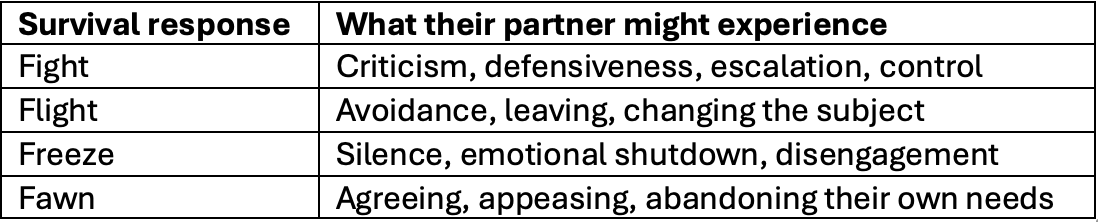
It's important to remember that these behaviours don't necessarily reflect how much someone loves or cares about their partner. They may reflect how that person has learned to protect themselves when they feel emotionally threatened.
Understanding where a survival response originated doesn't mean excusing harmful behaviour. Rather, it creates an opportunity to approach these patterns with greater awareness, compassion, and accountability.
How to Identify Your Own Survival Response
Developing an understanding of your survival responses starts with becoming curious about your experiences, particularly what you learned about emotions, conflict, and relationships growing up.
Consider reflecting on the following questions:
Looking Back at Childhood
- What did conflict look like in your childhood home?
- What happened when you expressed anger, sadness, or frustration?
- Did you feel safe disagreeing with your caregivers?
- Were your emotional needs acknowledged and validated?
- Did you feel responsible for keeping the peace?
- What did you learn you needed to do to receive love, approval, or attention?
Understanding Your Adult Relationships
- When you feel threatened in a relationship today, what are you afraid might happen?
- Do you tend to fight, withdraw, shut down, or accommodate others?
- What happens in your body when conflict arises?
- What does your nervous system perceive as dangerous, even if your adult mind knows you're safe?
- Are there particular situations or behaviours that seem to activate these responses?
The goal isn't to label yourself or determine which survival response you have. It's to begin recognizing the patterns that emerge when you feel emotionally unsafe.
Can You Change Your Survival Responses?
Absolutely.
Although our early experiences can shape how we respond to stress and navigate relationships, these patterns aren't permanent. With greater self-awareness, supportive relationships, and intentional practice, we can learn new ways of responding.
This often involves learning to:
- Recognize the physical and emotional signs that you're becoming activated.
- Identify the underlying emotions and needs beneath your protective behaviours.
- Communicate your feelings and needs more openly.
- Develop boundaries without feeling guilty.
- Tolerate discomfort without immediately reacting or withdrawing.
- Build relationships where vulnerability, disagreement, and emotional expression feel safe.
Therapy can also help you explore where these patterns originated and understand how they may be influencing your current relationships.
A Final Thought
Your survival responses aren't character flaws. They're often adaptations that once helped you cope, protect yourself, or maintain connection.
Whether you learned to fight, flee, shut down, or keep everyone happy, these patterns deserve curiosity rather than judgment.
The goal isn't to eliminate them, but to recognize when they show up, understand what they're protecting you from, and learn new ways of responding.
You may not have chosen the relationship patterns you learned in childhood, but you can shape the relationships you build as an adult.
At Map Psych, we help individuals and couples understand their patterns, improve communication, and build healthier, more connected relationships. Change is possible.